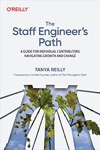
The Staff Engineer's Path by Tanya Reilly is a career book for engineers who have discovered that senior technical work does not automatically become clearer when the title gets bigger.
That is the quiet problem with the staff engineer track. Earlier engineering levels usually have a visible center of gravity: implement the feature, fix the bug, own the service, improve the system, mentor nearby engineers. At staff-plus levels, the work gets wider and less tidy. You are expected to create leverage, steer technical direction, make other people more effective, and notice problems before they become expensive. The job becomes less about having the hardest task assigned to you and more about making sure the right technical work happens at all.
That transition is not obvious. This book is useful because it treats staff engineering as a real job with real mechanics, not as a vague reward for being good at coding.
What The Book Is About
The Staff Engineer's Path is about technical leadership without defaulting to people management. That distinction matters.
A lot of companies say they have an individual contributor track, but the lived experience can be fuzzy. Engineers get promoted because they are strong technically, then suddenly need to influence roadmap decisions, align teams, mentor senior engineers, defuse architectural confusion, and decide where not to spend time. The title changes. The operating model often does not.
Reilly's book gives structure to that ambiguity. It talks about role modeling, technical strategy, execution, influence, sponsorship, communication, and the weird calendar math of being senior enough that everyone wants a piece of your attention.
The book is especially good at making invisible work visible. Staff engineers often do work that is hard to count: asking the question that prevents a bad design, connecting two teams that were solving the same problem separately, writing the document that lets a project survive beyond one person's memory, or declining work that would create more noise than value.
That kind of work matters. It is also easy to under-explain, under-measure, and under-reward unless the organization has a shared language for it.
Who Should Read It
The obvious reader is an engineer who is already staff-level or aiming in that direction. But I would widen the audience.
Senior engineers should read it before they think they need it. The transition from senior to staff is not just "more senior, but louder." It requires different habits: broader context, better prioritization, more explicit communication, and a willingness to create alignment instead of waiting for someone else to hand you a perfectly scoped technical problem.
Engineering managers should read it too. If managers do not understand staff engineering, they accidentally turn the role into a junk drawer: architecture review, emergency debugging, mentoring, project rescue, design docs, production escalation, hiring loops, roadmap translation, and whatever else does not fit cleanly elsewhere. That is how strong staff engineers burn out while looking successful from a distance.
Staff engineers need scope. Managers need to help protect that scope. This book helps both sides have a better conversation.
It pairs well with How to Use AI Coding Agents Without Losing Engineering Judgment because the underlying theme is the same: leverage is useful only when judgment remains intact.
What Works Well
The book's greatest strength is its practicality. It does not pretend that staff engineering is only grand architecture and elegant strategy. It talks about time, attention, relationships, credibility, and organizational reality.
That is good, because the staff role lives in the gap between technical correctness and human coordination. The best design does not matter if nobody understands it, trusts it, funds it, operates it, or migrates to it. A staff engineer who cannot communicate will have limited impact. A staff engineer who communicates beautifully but avoids technical depth is also a problem.
The book understands that tension.
It also avoids the trap of treating influence as personal branding fluff. Influence, in a healthy engineering organization, is not about being loud. It is about being trusted. Trust comes from doing the work, explaining tradeoffs clearly, giving credit, showing up when things are messy, and being right often enough that people want your input before the concrete sets.
That is a useful corrective. Many career discussions make staff-plus growth sound like a performance of authority. This book makes it sound more like sustained technical responsibility.
The Calendar Problem
One of the most recognizable staff engineer problems is calendar fragmentation. The more useful you are, the more people want your help. That sounds flattering until your week becomes design reviews, planning meetings, incident follow-ups, mentoring, architecture debates, Slack threads, and thirty-minute slices of technical work that require three hours of context.
The book is good at naming the need to manage attention deliberately. At staff level, saying yes to everything is not generosity. It is a prioritization failure with friendly packaging.
This is where staff engineering starts to feel less like coding and more like systems design. Your time is a constrained resource. Your attention has latency. Your involvement can become a dependency. If every important decision requires you personally, you have not created leverage. You have created a bottleneck with a better title.
That lesson applies beyond career management. It shows up in technical processes too. In How To Design CI Output That Humans Can Actually Debug, the goal is to reduce unnecessary human parsing. Staff engineering has a similar goal: reduce unnecessary dependency on heroic interpretation.
Strategy Without Theater
Technical strategy is one of those phrases that can either mean something important or absolutely nothing. The difference is whether it changes decisions.
A useful strategy helps teams choose. It clarifies what the organization is optimizing for, which tradeoffs are acceptable, which migrations matter, which platforms deserve investment, and which local wins would create global pain. It is not a slide deck with architecture nouns. It is a decision tool.
The Staff Engineer's Path is valuable because it frames staff engineers as people who help create that decision tool. Not alone, not by decree, and not as detached architecture astronauts. The work is collaborative, grounded, and connected to delivery.
That matters in real organizations. Technical direction is rarely set in one dramatic meeting. It emerges through design docs, review comments, prototypes, migrations, incident analysis, roadmap pressure, and repeated conversations. Staff engineers operate in that flow. They need enough technical depth to see consequences and enough organizational skill to move people through them.
Where The Book Is Less Technical
If you want a book about distributed systems, compilers, build tools, or code design, this is not that book. It is about the work around the technical work.
That is not a weakness, but readers should know what they are buying. The book will not teach you how to design a storage engine or debug a remote cache. It will help you think about how to lead a storage migration, how to choose where your expertise is most valuable, and how to avoid becoming the person everyone consults but nobody can scale.
For some engineers, that may feel soft. I would argue it is simply a different kind of hard.
The hardest staff-level problems are often socio-technical. The database is real. The deployment pipeline is real. The team boundaries are also real. So are incentives, trust, documentation gaps, ownership ambiguity, and the fact that every migration has to happen while the business keeps moving.
Ignoring that layer does not make you more technical. It makes you less effective.
Practical Takeaways
The book's practical value comes from how it changes your weekly behavior. A few lessons stand out:
- Define your role before your calendar defines it for you.
- Create leverage by making others more effective, not by becoming a required approver for everything.
- Treat technical strategy as a decision-making aid, not a branding exercise.
- Communicate tradeoffs in language your audience can act on.
- Build credibility before you need influence.
- Notice when you are solving the same class of problem repeatedly and turn it into a system.
- Protect enough focus time to remain technically grounded.
That last point is important. Staff engineers who drift too far from the work become abstract. Staff engineers who stay too deep in isolated implementation can miss the larger system. The job is a balancing act, and the balance changes by organization, team, and season.
AI, Leverage, And Staff Engineering
The book was not written as an AI coding guide, but its advice has become more relevant as AI tools change engineering workflows.
AI increases the amount of code and analysis a team can produce. That makes staff-level judgment more important. Someone still needs to decide which work should exist, which generated changes are safe, which abstractions are worth keeping, and which process changes will help the team rather than bury it in plausible noise.
That is staff engineering in miniature: create leverage, preserve judgment, and raise the quality of decisions around you.
It is also why Designing Guardrails for AI-Generated Pull Requests is a natural companion topic. Tools can increase throughput. Senior technical leaders have to make sure throughput does not outrun reviewability, ownership, and system understanding.
Verdict
The Staff Engineer's Path is one of the better books for engineers trying to understand senior individual contributor leadership. It is practical without being shallow, career-focused without being cynical, and honest about the ambiguity of the role.
Read it if you are moving toward staff-level work. Read it if you already have the title but feel like the job is mostly transmitted through folklore. Read it if you manage staff engineers and want to avoid turning your strongest technical people into an escalation queue.
The best staff engineers do not merely solve harder problems. They improve the system that chooses, frames, solves, and maintains those problems. This book is a useful guide to that shift.
More at Slaptijack.