The move from senior engineer to staff engineer is not just a promotion with a bigger title and more meetings.
It is a change in the operating model.
Senior engineers are usually rewarded for strong execution inside a meaningful scope. They can take ambiguous work, turn it into a plan, make good technical tradeoffs, ship reliable systems, mentor nearby engineers, and raise the quality of the team around them. That is real work. It is also why the senior level is such a durable career destination for many excellent engineers.
Staff engineering asks for something different.
At staff level, the question is less "Can you execute this difficult project?" and more "Can you help the organization choose, shape, and sustain the right technical work?" The work gets broader, messier, and more indirect. You still need technical depth, but depth alone is no longer enough. You need leverage, judgment, communication, trust, and a much better sense of where your personal involvement helps versus where it quietly becomes a dependency.
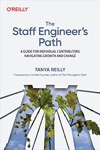
This article builds on The Staff Engineer's Path Review. That review is about Tanya Reilly's book and why it is useful. This piece is about the practical transition: what actually changes when a strong senior engineer starts operating like a staff engineer.
The Center Of Gravity Moves From Output To Leverage
Senior engineers are often high-output people. They close hard bugs, unblock projects, review important code, simplify systems, and generally make the local engineering environment better.
That output still matters at staff level. A staff engineer who cannot reason deeply about code, architecture, operations, or tradeoffs is going to have a credibility problem.
But the center of gravity shifts.
At staff level, your personal output is only one part of your impact. The larger question is what your work enables other people to do:
- Did you make a hard technical decision easier to understand?
- Did you reduce risk across multiple teams?
- Did you help a team avoid six months of elegant waste?
- Did you create a migration path people can actually follow?
- Did you improve the quality of decisions without personally owning every decision?
- Did you support engineers and managers in seeing the system more clearly?
This is where senior engineers sometimes get stuck. They keep trying to prove readiness by doing more senior-engineer work: more tickets, more reviews, more heroic debugging, more meetings, more personal ownership. The calendar fills up. The output looks impressive. The organization becomes more dependent on them.
That can earn strong ratings. It does not automatically demonstrate promotion readiness.
Ratings are about the impact you had. Promotions are about how you had that impact. A senior engineer can have excellent impact by directly driving a project through the wall. A staff engineer is expected to create impact in a way that scales through technical direction, better framing, stronger systems, and other people becoming more effective.
Ambiguity Becomes Part Of The Job
At senior level, ambiguity often arrives as a poorly specified project:
- The requirements are fuzzy.
- The system behavior is inconsistent.
- The stakeholders disagree.
- The codebase has historical sediment.
- The deadline is real enough to be annoying.
A good senior engineer can turn that into executable work.
At staff level, the ambiguity often starts earlier. The organization may not even agree on what problem it is solving. Two teams may both be locally correct and globally misaligned. A platform migration may be technically sensible but economically wrong this quarter. A reliability problem may look like an implementation issue when the deeper problem is ownership, feedback loops, or operational incentives.
Staff engineers are expected to operate in that fog without waiting for a tidy ticket.
That does not mean becoming an architecture oracle. It means developing the habit of clarifying:
- What decision are we actually making?
- Who is affected by this decision?
- What constraint is real, and what constraint is assumed?
- What would we do differently if the deadline moved?
- What risk are we accepting by doing nothing?
- What would be good enough for now?
- What evidence would change our mind?
There is a very practical bias-for-action version of this: done is better than perfect, but only if you are honest about what "done" means. Staff-level judgment is not endless analysis. It is knowing when to move, what to preserve, what to defer, and how to make the tradeoff visible enough that other people can trust it.
You Stop Waiting For Scope To Be Handed To You
Senior engineers can often succeed by executing assigned scope extremely well. They may negotiate details, reshape pieces of the plan, and flag problems, but the general frame of the work is usually visible.
Staff engineers are expected to help create scope.
That can be uncomfortable because it feels less concrete than implementation. No one hands you a perfect staff-level project labeled "please demonstrate broad technical influence here." You have to notice the work that matters before it has a clean shape.
Useful staff-level scope often looks like:
- A repeated class of incidents across several services.
- A platform migration that needs a credible adoption path.
- A build or deploy bottleneck that slows multiple teams.
- A product architecture that makes every new feature more expensive.
- A technical strategy gap between leadership goals and engineering reality.
- A team that keeps making the same design mistake because the system nudges them there.
The trap is turning every problem you notice into your personal queue. That is not staff engineering. That is becoming the organization's most expensive escalation handler.
The better move is to support the system around the problem. Sometimes that means writing the design doc. Sometimes it means mentoring the engineer who should own the work. Sometimes it means building a proof of concept. Sometimes it means saying, clearly and calmly, that the proposed project is not worth the organizational cost.
Scope is not "more stuff." Scope is meaningful leverage.
Communication Becomes A Technical Skill
A lot of engineers underinvest in communication because they think of it as soft work.
That is a mistake.
At staff level, communication is part of the technical system. Architecture does not exist only in diagrams and repositories. It exists in what teams understand, what managers can fund, what reviewers can maintain, what on-call engineers can debug, and what future engineers can safely change.
A staff engineer's communication needs to do several jobs:
- Make complex technical tradeoffs legible.
- Preserve nuance without hiding the recommendation.
- Create shared vocabulary across teams.
- Expose risks early enough to matter.
- Help managers understand engineering reality without drowning them in detail.
- Help engineers understand business constraints without turning into a spreadsheet.
- Document decisions so the organization does not have to rediscover them every quarter.
This is where the job can feel surprisingly editorial. A good staff engineer often spends a lot of time naming things: the problem, the constraint, the recommended path, the rejected alternatives, the migration stages, the failure mode, the owner, the next decision.
That naming is not decoration. It is how a group of smart people stops arguing past each other.
Influence Replaces Authority As The Default Tool
Most staff engineers do not have formal authority over the people whose work they affect.
That is healthy. The staff role should not be a manager-shaped shadow role with fewer explicit responsibilities. The best staff engineers support teams by making technical direction clearer, risks more visible, and execution easier. They do not win by collecting unofficial direct reports.
Influence is not manipulation. It is earned trust.
You earn it by:
- Being technically credible.
- Giving advice that survives contact with reality.
- Listening before prescribing.
- Understanding local constraints.
- Following through.
- Admitting when you are wrong.
- Making other people more successful instead of making every decision route through you.
The last point matters. A staff engineer who needs to personally approve every interesting technical decision has created a bottleneck. It may feel like high impact because everyone is asking for help. From a systems perspective, it is latency.
The better pattern is to raise the quality of the decision-making environment: clear principles, better examples, reusable templates, sharper review criteria, stronger feedback loops, and enough coaching that teams can make more good decisions without waiting for you.
Your Calendar Becomes A Design Problem
Senior engineers can usually protect a decent amount of maker time. Not always, but often enough that the job still has a recognizable implementation rhythm.
At staff level, your calendar can turn into a distributed systems problem with bad defaults.
Every meeting may be defensible in isolation:
- A design review needs your context.
- A planning meeting needs technical reality.
- An incident follow-up needs pattern recognition.
- A manager wants help coaching a senior engineer.
- A team wants feedback on a migration plan.
- A product partner wants to understand an engineering constraint.
Then Friday arrives and you have done twenty useful things while making no progress on the one thing only you were supposed to move forward.
This is not a personal productivity quirk. It is a role-design problem.
Staff engineers need to treat attention as a constrained resource. That means being deliberate about where you engage deeply, where you offer lightweight feedback, where you delegate, and where you decline. "What would you do if you weren't afraid?" is a useful question here. Sometimes the answer is: cancel the meeting, write the decision, ask the team to propose a recommendation, or stop being the default reviewer for work someone else can own.
Protecting attention is not selfish. It is how you keep the role from collapsing into calendar confetti.
The Work Gets More Indirect, But Not Less Technical
One fear senior engineers have about staff-level work is that it will pull them away from real engineering.
That can happen. It is also not what the role is supposed to be.
Staff engineering is still technical work, but the artifact is often larger than a diff. The artifact may be:
- A decision record.
- A migration strategy.
- A reference implementation.
- A service boundary.
- A reliability model.
- A deprecation plan.
- A build-system simplification.
- A set of review principles.
- A coaching loop that helps senior engineers operate with more independence.
Some weeks you will write code. Some weeks your most important contribution will be preventing the wrong code from being written. Some weeks you will translate a vague executive goal into engineering choices. Some weeks you will sit with a team long enough to notice that the real problem is not the component everyone is arguing about.
The technical bar does not go down. The surface area goes up.
What To Practice Before You Have The Title
You do not need to wait for a staff title to start building staff-level habits. In fact, waiting is usually a mistake.
Practice these while you are still senior:
- Write crisp problem statements before proposing solutions.
- Ask who else is affected by a technical decision.
- Turn repeated local problems into reusable guidance.
- Mentor without taking the keyboard away.
- Make tradeoffs explicit in design docs and pull requests.
- Look for second-order effects: operations, migration, ownership, support, and future maintainability.
- Help your manager understand the technical shape of a problem early.
- Decline work that would make you a bottleneck without creating leverage.
- Build credibility by shipping, not by narrating ambition.
The goal is not to cosplay the next level. The goal is to practice the operating model before the stakes get higher.
Promotion processes vary by company, and I am deliberately not pretending there is one universal checklist. But the durable pattern is simple: strong current level performance is necessary, and next-level operating evidence is different. You need to show not only that your impact is large, but that you create that impact in the way expected of a staff engineer.
The Practical Shift
Here is the short version.
Moving from senior engineer to staff engineer changes the job in five important ways:
- From personal output toward organizational leverage.
- From assigned ambiguity toward problem framing.
- From local execution toward cross-team technical judgment.
- From being helpful everywhere toward being deliberate about where your help scales.
- From communication as status reporting toward communication as engineering infrastructure.
The title is not the point. The operating model is the point.
A strong senior engineer can carry a hard project. A strong staff engineer helps the organization choose and execute better technical work, while making the people around them more capable. That is a different kind of value. It is less tidy, less private, and sometimes less immediately satisfying than closing the hardest ticket yourself.
It is also where a lot of the most interesting engineering leadership happens.
More practical engineering leadership and software craft writing lives at Slaptijack.