Many excellent senior engineers stall before staff engineer for a simple reason: they keep optimizing for the job that made them successful.
That is not a character flaw. Senior engineers are usually promoted because they can take hard work, make it concrete, and get it across the finish line. They debug the expensive failure, make the uncertain design implementable, improve a service nobody else wants to touch, review the risky change, and help nearby engineers become more effective. Those are valuable habits. Organizations need people who do that well.
The trouble starts when an engineer tries to make the next-level case by doing more and more of the same work. Their output goes up, their calendar fills up, and their name becomes attached to every difficult project. They may be a top performer, but the system is increasingly organized around their personal intervention. That can produce an excellent rating. It does not necessarily show staff-engineer readiness.
The move to staff is an operating-model change, not a reward for being the fastest senior engineer. What Actually Changes When You Move From Senior Engineer To Staff Engineer lays out that change. This article is about the common stalls before it: how to recognize them, what they cost, and what to do instead.
The Most Common Stall: Becoming the Heroic Escalation Queue
A strong senior engineer often becomes the person people call when a project is late, an incident is confusing, or two teams are stuck. At first, that is a reasonable use of expertise. The problem is what happens next.
Every rescue creates a small organizational lesson: when something is hard, wait for this person. The senior engineer gets a reputation for being helpful. Their manager gets a source of confidence. Other teams get their immediate problem solved. Meanwhile, the underlying ownership gaps, unclear interfaces, and weak decision paths stay in place.
That pattern feels like scope because it touches a lot of work. It is usually dependency disguised as importance.
Staff-level leverage means asking a different question after the immediate fire is out: why did this problem need this exact person? The answer might be a missing runbook, an API boundary nobody owns, a platform capability that has no adoption path, or a decision that was never made explicit. Fixing that system does not mean refusing to help in a real emergency. It means treating the emergency as evidence, not as the whole job.
Try this after a rescue:
- Name the recurring class of failure, not just the incident.
- Identify who should be able to handle it next time.
- Leave behind a decision record, tool, test, ownership clarification, or teaching moment that changes the next response.
- Decide whether your continuing involvement adds judgment or simply delays someone else learning.
The goal is to support teams, not quietly become their permanent control plane.
Output Is Necessary, but It Is Not the Promotion Argument
Senior engineers who stall are often visibly productive. They close tickets, ship features, write clean code, run productive meetings, and help with hiring or mentoring. None of that stops mattering at staff. A staff engineer still needs technical credibility and a willingness to get into the details.
But volume is not a complete story about larger scope.
At the staff boundary, people start looking for evidence that you can make good technical work more likely across a broader area. That may show up as a design that several teams can adopt, a migration plan that turns an impossible-looking change into incremental work, a better framing of a risky investment, or a technical strategy that changes what teams choose to build.
This is why the distinction between ratings and promotions matters. Ratings are about the impact you had. Promotions are about how you had that impact. A senior engineer may earn a strong rating by personally driving a difficult project through the wall. A staff engineer needs to show next-level impact in the way the next level expects: through durable direction, broader judgment, and leverage that does not require personal heroics every time.
If your weekly summary is mostly a longer list of things you personally completed, it is worth adding a second view: what became easier, safer, faster, or clearer for other people because of your work?
Waiting for Someone to Hand You Staff Scope
Another stall is waiting for the perfect staff-shaped assignment.
Senior-level work often arrives with a reasonably clear frame: build this, repair that, own this service, deliver this roadmap item. The work can still be ambiguous, but it has a visible container. Staff-level opportunities often start before that container exists. The organization may not agree on the real problem, who is affected, or whether the work is worth doing now.
That does not mean inventing projects to look strategic. It means paying attention to recurring friction with real consequences:
- Several teams are each building a slightly different workaround.
- Incidents point to the same missing ownership boundary.
- A platform is technically sound but adoption keeps failing.
- A recurring roadmap debate has no shared decision criteria.
- The cost of a local shortcut keeps appearing in other teams' work.
The staff move is to make the situation legible. Gather the relevant people, state the decision, identify constraints, describe the viable options, and propose a small next step that produces evidence. You may write a design doc, build a proof of concept, or help another engineer own the execution. The important part is not personally claiming all of it. It is helping the system choose and sustain useful work.
Treating Influence as a Communication Problem
Engineers sometimes describe influence as politics, then decide they would rather stay technical. That framing gives up too much.
Influence at staff level is mostly a technical communication skill. A sound architecture that nobody understands will not be adopted. A real risk that is only explained in implementation language may not receive funding. A migration that is correct but impossible for teams to stage will become shelfware.
The remedy is not to become louder or more performative. It is to match the communication artifact to the decision:
| Situation | Useful staff-level artifact |
|---|---|
| Teams disagree on a direction | Short decision memo with options and tradeoffs |
| A migration needs buy-in | Adoption plan with milestones, owners, and escape hatches |
| Leadership needs to choose an investment | Clear problem statement, consequences, and recommendation |
| Engineers need to execute consistently | Reference implementation, guardrails, and a practical guide |
| An incident exposes a systemic issue | Follow-up that changes ownership, signals, or operating practice |
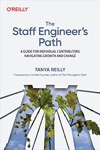
Good communication does not soften technical judgment. It makes the judgment available to people who need to act on it. That is one reason The Staff Engineer's Path is worth reading: it treats technical leadership as real work, rather than as a vague aura around the strongest engineer in the room.
Expanding Scope by Hoarding Decisions
The most subtle stall is taking ownership of every important decision yourself. It looks responsible. It can even create short-term quality. But it limits the number of decisions the organization can make well.
A staff engineer should be involved where their judgment changes the outcome. That is different from being the required reviewer, architect, or approver for every consequential change. The latter turns expertise into a bottleneck.
Build systems instead of personal queues:
- Write down decision principles that teams can apply without you.
- Develop senior engineers who can own the next design review.
- Create templates and reference implementations where repetition is useful.
- Be explicit about which decisions are reversible and should move quickly.
- Reserve your deep involvement for the irreversible, cross-team, or unusually risky work.
There is a healthy bias-for-action here. Done is better than perfect when a reversible decision needs to move. But staff judgment also means knowing which decisions create long-lived constraints. The job is not to make every choice personally. It is to improve the quality and speed of the choices the system makes.
A Practical Stall Diagnosis
Before your next career conversation, write down three examples of work from the last six months. For each one, answer:
- What problem did it solve beyond the immediate project?
- Who became more effective because of it?
- What continued to work after you stepped away?
- Did it change a decision, a system, an interface, or a capability across more than one local task?
- What would have happened if you had not personally intervened?
The answers do not need to be dramatic. They need to be honest. If most of the work disappears when you step away, the next growth move is probably to build a clearer system around it. If you can show that teams made better decisions, avoided repeat pain, or delivered more safely without increasing dependency on you, you are building staff-shaped evidence.
Move From Helpful to Leveraged
Stalling before staff does not mean an engineer lacks ability. More often, it means they have mastered a highly valuable senior-engineer model and need to deliberately add a different set of habits.
Keep the technical depth. Keep the bias for action. Keep helping when the work is hard. Then add the harder discipline: create scope from real organizational friction, make tradeoffs understandable, support other people in owning the work, and leave systems behind that work when you are not in the room.
That is how strong senior engineering becomes staff-level leverage. It is not less technical. It is technical judgment applied to a larger system.
More at Slaptijack.