The difference between staff engineer impact and senior engineer output is not that staff engineers stop writing code.
The difference is that output describes what you personally produced, while impact describes the useful change that persists because you were involved.
Senior engineers need both. They are expected to ship difficult work, make sound technical decisions, and improve the engineering around their immediate team. A strong senior engineer can take a fuzzy project and turn it into working software. That remains a meaningful and complete career destination.
At staff level, personal output becomes a smaller part of the story. The question is not only whether you delivered an excellent system or fixed a hard problem. It is whether your work changed the capability of an area larger than your own task list: did teams make better decisions, adopt a safer path, avoid repeat failure, or deliver important work with less friction because of what you did?
That is a subtle distinction, and it is why good senior engineers can feel confused by staff expectations. They already produce excellent work. What needs to change is not effort. It is the model for creating leverage.
This builds on What Actually Changes When You Move From Senior Engineer To Staff Engineer and Why Senior Engineers Stall Before Staff Engineer. The first explains the operating-model shift. The second covers the traps. This article makes the distinction practical when you are choosing work or explaining its value.
Output Is Visible; Impact Needs a Causal Story
Output is usually easy to count:
- You designed and launched a service.
- You closed a set of production bugs.
- You migrated a system.
- You reviewed a large number of pull requests.
- You wrote a design document or implemented a platform feature.
Those are real accomplishments. They should be visible in planning, status updates, and performance discussions.
Impact asks one additional question: what changed because of that output?
For example, a senior engineer may build a new deployment tool that their team uses successfully. A staff engineer may still build part of the tool, but their larger contribution could be identifying the shared delivery problem, aligning several teams on a small common interface, defining an adoption path, and making the tool safe enough that teams can move without waiting for individual approval. The code matters. So do the decision, the migration, and the capability that remains after the author turns to something else.
Neither version is morally better. They solve different organizational needs. The senior version may be exactly what the moment requires. The staff version is evidence of broader judgment and durable leverage.
The Same Work Can Produce Different Levels of Impact
Titles do not automatically turn a project into staff work. The same work can be approached with either a primarily output-oriented or impact-oriented model.
| Situation | Strong senior-engineer output | Staff-engineer impact |
|---|---|---|
| Repeated CI failures | Fixes the failing pipeline and documents the issue | Identifies systemic failure patterns, improves the feedback loop, and helps teams adopt a debuggable standard |
| Platform migration | Delivers a safe migration for one service | Creates decision criteria, an incremental path, and guardrails that let several teams migrate safely |
| Production incident | Restores service and writes a careful postmortem | Changes ownership, observability, or operating practices so the class of failure is less likely and easier to handle |
| Architecture disagreement | Produces a technically sound design | Helps the relevant groups make and record a decision they can execute and revisit without endless relitigation |
| New engineer growth | Mentors a teammate through a hard project | Creates opportunities and expectations that help several senior engineers take on meaningful technical ownership |
The staff column is not about making every task bigger. It is about looking for the system around the task. If the right answer is a narrow fix, do the narrow fix. If the failure is repeating across teams, a one-off repair is probably not enough.
Do Not Confuse Bigger Projects With Bigger Impact
The most common mistake is treating project size as a proxy for staff scope. A huge migration can be mostly senior-level output if its boundaries, architecture, owners, and success criteria are already defined. A staff engineer may help deliver it, but executing a large assigned project does not by itself demonstrate staff impact.
Conversely, a small piece of work can be staff-shaped if it changes how an organization makes a repeated class of decisions. A short proposal that exposes an expensive interface problem, creates an adoption agreement, and prevents several teams from building incompatible solutions may have more leverage than months of individual implementation.
This is why staff work often feels harder to describe. The deliverable is not always a repository or a launch. It may be a clearer decision, a shared model, a safer operating constraint, or a team that no longer needs an expert in every room.
That work must still be concrete. “Influenced technical strategy” is not useful evidence on its own. A credible impact story identifies the decision, the people or systems affected, the tradeoff, and the observable result.
Scope Is About Consequences, Not Attendance
Staff engineers tend to have more cross-team interaction, but being invited to more meetings is not staff impact. Meetings are an input. The question is what changed because you were there.
A useful test is to ask where the consequences of the work land:
- Does it make one engineer faster, or a whole team safer?
- Does it resolve a local ticket, or reduce a repeated category of work?
- Does it clarify one implementation, or give several teams a decision they can apply consistently?
- Does it depend on your continued attention, or can the organization carry it forward without you?
The last question is particularly important. Staff engineers should remain technically engaged, but their involvement should not be a permanent runtime dependency. If every important decision requires your personal review, you may be providing value while also limiting the system's capacity.
The better pattern is to stay close enough to consequential decisions to add judgment, then create mechanisms that make the next decision easier: a reference implementation, clear interface, decision record, owner model, metric, or teaching loop.
Turn Output Into an Impact Narrative
You do not need to turn ordinary work into grand strategy. You need to explain the connection between your work and the capability it created.
An output-only summary might say: “Built a new release validation service and migrated three applications.”
An impact-focused summary might say: “Reduced a recurring release-risk pattern by defining a common validation contract, proving it with three applications, and leaving an adoption path that other teams could use without bespoke help.”
The second version is not inflated. It is more complete. It includes the technical output, the problem class, the initial evidence, and the durable mechanism.
Use this template for work you want to evaluate:
- What repeated problem or decision did this address?
- Who was affected beyond the immediate project?
- What did I personally produce?
- What changed in other people's ability to decide, build, operate, or learn?
- What persists when I stop personally driving it?
- What evidence would show that the impact is real rather than aspirational?
This also improves status writing. A list of activity can hide the important part of a staff engineer's contribution. A concise causal story makes the judgment and leverage visible without resorting to vague leadership language.
The Tradeoff: Staff Engineers Still Need Technical Grounding
There is a bad caricature of staff engineers as people who have escaped the details and now only write documents or attend strategy meetings. That is not a useful goal.
Technical grounding is how staff engineers evaluate proposals, notice hidden costs, earn trust, and understand when a clean-looking plan will fail in the real system. The right amount varies by role and organization, but a staff engineer who cannot engage with implementation, operations, architecture, or developer experience will eventually become abstract.
The tradeoff is not code versus influence. It is personal output versus the highest-leverage use of personal output. Sometimes the best staff move is to write the prototype that makes a disputed path real. Sometimes it is to pair with the engineer who should own the implementation. Sometimes it is to stop writing code long enough to resolve the decision that is making everyone else's code expensive.
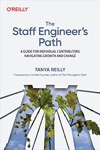
The Staff Engineer's Path is a useful companion because it treats that balancing act as a real job with real mechanics, rather than a promotion-level personality test.
Choose Work That Leaves the System Better
Senior engineers do not need to abandon direct execution to grow toward staff. They need to get more deliberate about the systems their execution changes.
When you choose a project, look past the launch. Ask whether you can make a technical decision clearer, reduce a repeating failure mode, create an adoption path, support another engineer in owning a consequential problem, or replace a personal dependency with a useful capability.
Those are staff-engineer impact patterns. They are not a universal checklist, and they should never become theater. They are a way to direct strong technical output toward outcomes that survive, spread, and make the organization more capable.
More at Slaptijack.