Articles by Scott Hebert

  1. ncutil - OS X's Missing Network Configuration Utility

    Posted on in System Administration

    If you've ever had to administer a Mac OS X system from afar, you know how difficult it can be to manage network settings. The Network Preference Panel under System Preferences is a great tool if you have remote access to the <acronym title="Graphical User Interface">GUI</acronym>, but …

  2. Post #100! (Cue Confetti)

    Posted on in Graphics Design

    Welcome to post #100! Since this is a bit of a milestone, I thought I'd put up a super chart.

    The image below shows the grow of RSS subscribers over the last 100 posts.
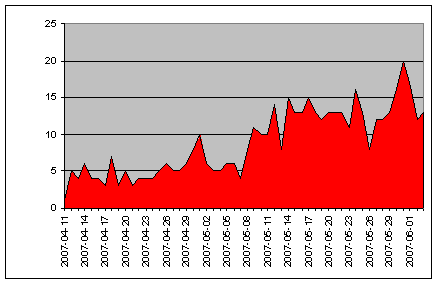
    RSS Subscriber Growth as of Jun 4, 2006.

    Although the growth is modest, I think its impressive considering this site has lived between Google …

  3. OS X Caching Only Name Server

    Posted on in System Administration

    By default, Mac OS X 10.4 (Tiger) comes with BIND 9 pre-installed and pre-configured to operate in caching-only mode. Unfortunately, the operating system is not configured to start the server at boot time, or even use the server if it was running. In this series of articles, we'll create …

  4. How To Hide Your BIND Version

    Posted on in Software

    By default, a BIND DNS server will report which version it is running to anyone that's interested. All it takes is a simple lookup of the version.bind text record in the chaos class of your server. Check this out:

    Skadi:~ slap$ dig version.bind txt chaos @localhost
    
    ; <<>> DiG 9 …
  5. Slaptijack Site Shake-Up

    Posted on in Software

    It's recently come to my attention that a large percentage of the Slaptijack site has ended up in the dreaded "Google Supplemental Index". This means that key pages are not being served during normal searches. You can see which pages are in the Supplemental Index by running the following search …

  6. How Do You Want Your DS3? Scrambled?

    Posted on in Networking

    DS3 (also known as T3) scrambling is not an issue that comes up very often. It's something every network administrator should know about, though. After all, it just might save your bacon.

    Some physical layer protocols depend on the transition from 1 to 0 in a frame to maintain clocking …

  7. 3 Reasons You Should Be Using Rapid Spanning Tree (802.1w)

    Posted on in Networking

    Most network administrators should be familiar with Spanning Tree Protocol (STP; IEEE 802.1D). <acronym title="Spanning Tree Protocol">STP</acronym> is tasked with ensuring there are no loops in a bridged network. Unfortunately, STP is an older protocol and doesn't quite mesh with today's high speed networks. Here are …

  8. Gmail Has Ads?

    Posted on in Software

    This is just a little humorous anecdote along the lines of frantically searching the house for the glasses you happen to be wearing. After yesterday's somewhat "heavy" post, I thought the mood needed a little lightening.

    I've only recently (in the last month or so) begun using Gmail as my …

  9. Controlling Peer-to-Peer (P2P) Traffic with Cisco NBAR

    Posted on in Networking

    Is your network bandwidth being consumed by Peer-to-Peer (P2P) traffic? (Hint: If you don't know, it's time to fire up NBAR and do a little investigating.) One way to stop P2P traffic is to use an access-list to block traffic on the well-know P2P ports. Unfortunately, many P2P technologies no …

  10. Using Mutt with IMAP

    Posted on in Software

    I've written before regarding the command-line email client Mutt, and how useful it can be. Unfortunately, Mutt is designed to read a local mail spool by default. If you need to use Mutt to read email from a remote mail server, <acronym title="Internet Message Access Protocol">IMAP</acronym> may …

Slaptijack's Koding Kraken